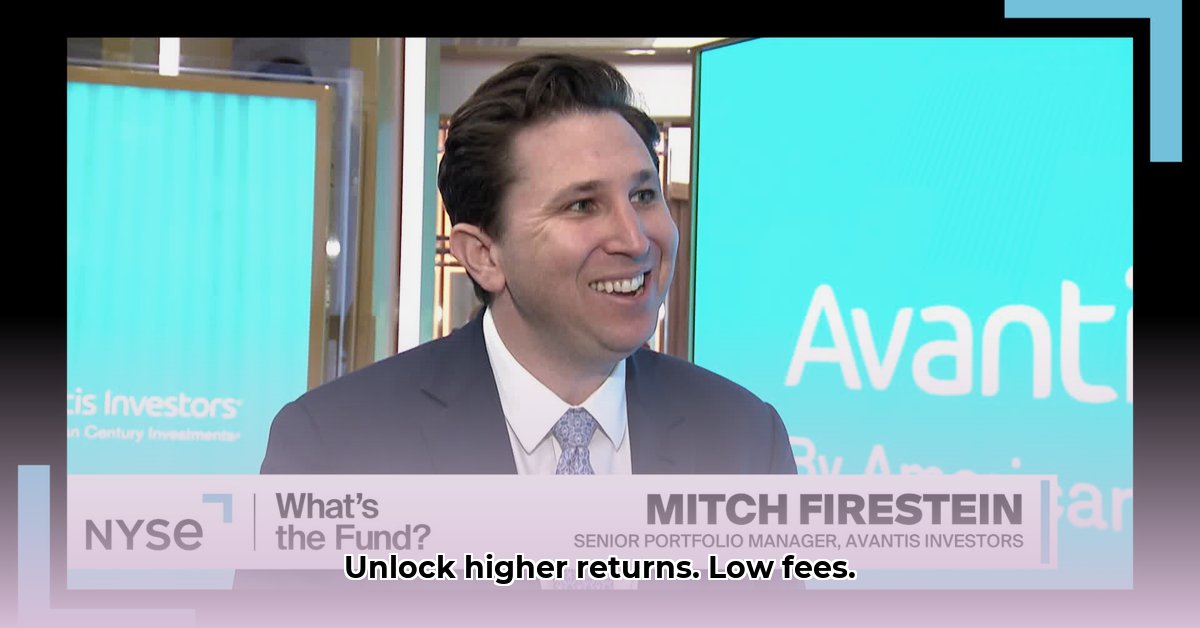
Avantis Fund: A Hybrid Approach to Investing
Tired of the investment world's binary choices—high fees for active management or low returns with passive investing? Avantis Fund offers a compelling alternative: a hybrid active-passive strategy designed to potentially deliver higher returns while maintaining lower costs. This isn't a get-rich-quick scheme; it's a nuanced approach blending quantitative modeling with expert oversight. This article dissects Avantis's strategy, explores its advantages and disadvantages, and provides actionable intelligence for potential investors.
How Avantis Fund Works: Blending Active and Passive Strategies
Avantis leverages a sophisticated quantitative valuation model to identify potentially undervalued companies (companies the model believes are priced below their intrinsic value). These selections are then incorporated into a diversified Exchange-Traded Fund (ETF) structure, instantly spreading risk across numerous assets. Think of it like assembling a diverse portfolio of fruits instead of relying solely on a single apple. But the strategy doesn't stop at passive investment. A team of expert portfolio managers actively monitors and adjusts the ETF holdings based on real-time market dynamics, constantly striving for optimization. The intended outcome? Potentially exceeding the returns of traditional passive investments while significantly undercutting the fees associated with actively managed funds. This blend aims to capture the best of both worlds. Is this approach truly superior? Let's delve deeper.
Advantages and Disadvantages: A Balanced Perspective
Avantis Fund presents a compelling proposition, but it's crucial to acknowledge both its potential benefits and inherent risks.
Advantages:
- Lower Fees: By utilizing a primarily ETF-based structure, Avantis aims to significantly reduce management fees, placing more returns in your pocket. How much lower are those fees? That will depend on current market situations and the specific ETF.
- Diversification: The ETF structure inherently provides diversification, reducing the impact of any single asset's underperformance. This broad exposure minimizes risk, protecting your investment from unforeseen market shifts.
Disadvantages:
- Model Dependence: The fund’s success hinges on the accuracy of its quantitative model. Market conditions are inherently unpredictable, and the model's valuation estimations might not always prove accurate which might hinder overall returns.
- Market Volatility: While diversification mitigates risk, market volatility remains an inherent risk in any investment strategy. Even carefully chosen assets can decline in value during market downturns.
Avantis Fund: Competitive Landscape and Investor Considerations
Avantis occupies a unique niche, bridging the gap between actively managed funds (higher fees, higher potential returns) and passive index funds (lower fees, lower potential returns). While other firms offer similar blended strategies, Avantis's specific quantitative model and active management approach differentiate it. Comparing Avantis to direct competitors requires a detailed analysis of their respective methodologies, fee structures, and performance data – information readily available through reputable financial resources.
Actionable Intelligence for Investors:
- Assess your risk tolerance: Are you comfortable with potential volatility in the pursuit of potentially higher returns?
- Conduct thorough due diligence: Independently research Avantis's methodology, fee structure, and historical performance (if available).
- Diversify your broader investment portfolio: Don't concentrate your investments solely in Avantis. Spread your assets across multiple different areas.
- Consult a financial advisor: A qualified financial advisor can help determine if Avantis aligns with your unique financial goals and risk profile.
Conclusion: Navigating the Avantis Opportunity
Avantis Fund presents a compelling investment strategy aimed at maximizing returns while minimizing costs. Its unique hybrid approach combines the precision of active management with the cost-effectiveness of passive indexing. It will need to continue to prove its capabilities in the long run. However, potential investors must meticulously weigh the potential benefits against the inherent risks. Remember, no investment guarantees success. Thorough due diligence, including independent research and professional financial advice, is crucial before making any investment decisions.